
Transfer Agent Services
2026 US Annual Meetings Report

What is the outlook for private companies considering a move to go public this year?
After several subdued years following the record IPO boom of 2021, the US public offering market has shown renewed momentum in 2026, although market conditions remain uncertain. Investment banks report a steady pipeline of companies preparing to test the public markets, while institutional investors have demonstrated willingness to support new listings – particularly in technology, AI and digital platforms.
But the central question facing corporate boards and executive teams is not simply whether the IPO window is reopening. It is whether their organizations are prepared to operate as public companies in an environment that remains volatile and fast-moving.
Beyond the question of whether the IPO window is reopening, the opportunity for corporate boards and executive teams lies in ensuring their organizations are ready to succeed as public companies.
Several trends are shaping the next phase of the IPO cycle.
First, the market recovery has been uneven but real. While deal volumes remain below 2021 peaks, total capital raised has increased, driven by larger transactions. This reflects a market that is selective rather than inactive.
Second, investor appetite has concentrated around specific sectors – particularly technology and AI-related infrastructure. These companies have benefited from strong narratives and scalable business models, but this concentration also introduces risk. A narrow sector focus can amplify volatility if sentiment shifts.
Third, SPAC activity has shown signs of stabilization after a sharp decline, though structural constraints – such as limited Private Investment in Equity (PIPE) financing – continue to limit widespread adoption.
This shift reflects a broader change in investor behavior: public market participants are prioritizing durability and profitability over growth at any cost.
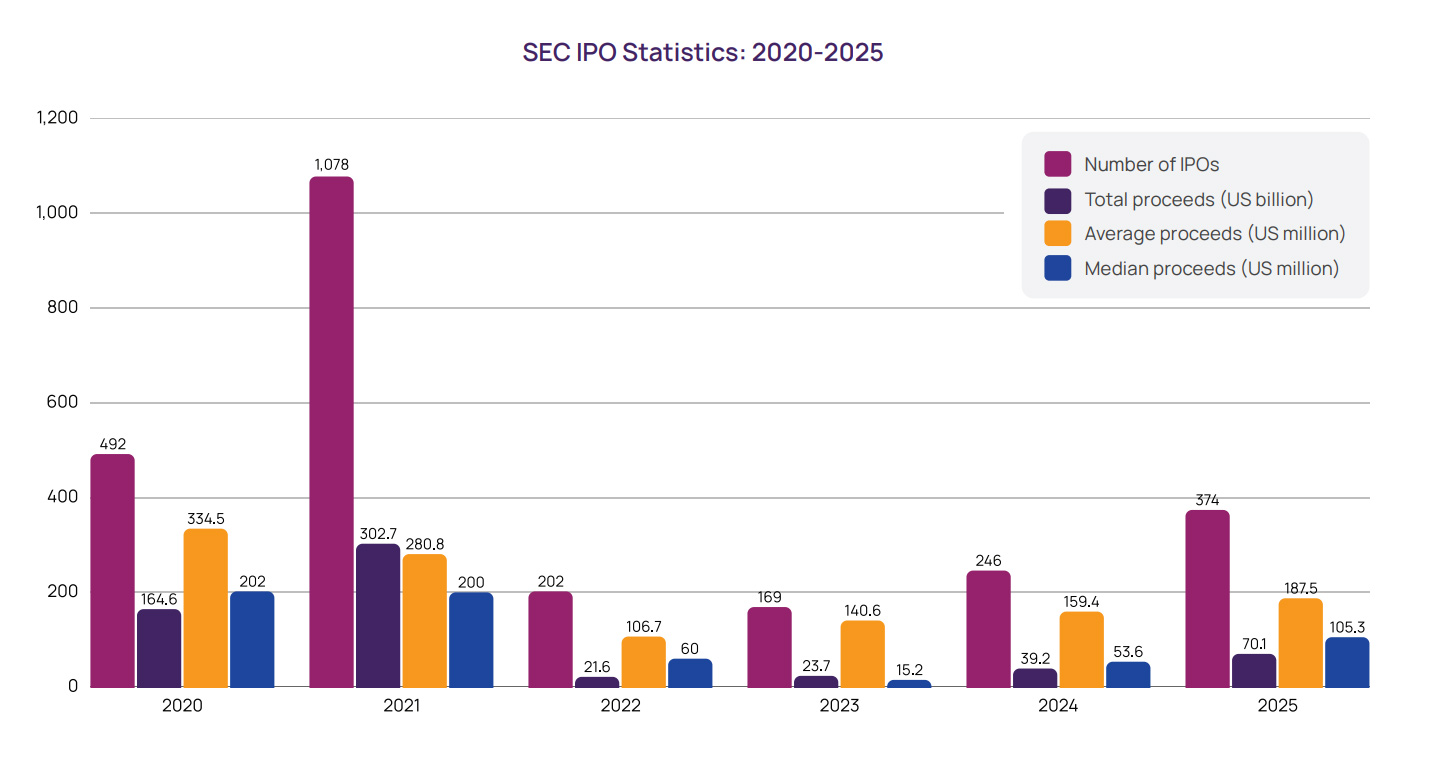


Issuers entering the public markets must plan for a defined set of requirements that come with operating as a public company, including expanded disclosure, enhanced financial reporting, and disciplined market timing, as well as the costs associated with listing and life as a public issuer.
For a $200 million IPO, costs typically range from $15 to $25 million3.
With a proven history of helping public companies grow and adapt, Computershare is recognized as an industry leader, especially in addressing critical IPO challenges such as lock-up management and release. Our integrated approach ensures that clients can confidently navigate evolving regulatory landscapes, optimize corporate actions, and foster meaningful investor relationships, all while maintaining operational excellence and strategic agility. These capabilities help newly public companies manage the operational complexity that follows a successful initial offering.
1 https://www.sec.gov/data-research/statistics-data-visualizations/initial-public-offerings-ipos
2 Nasdaq Welcomed 171 IPOs in 2024 | Nasdaq
3 The Costs of Going Public - IPOHub, The Costs of Going Public by Caleb Christiansen, published March 27, 2018, updated September 2, 2023.
If you are considering going public, you will need an experienced transfer agent. Learn more about our full range of solutions for your IPO and moving forward as a public company.