A clear, practical guide to AI terminology - and how it shows up in entity management today
Artificial Intelligence (AI) is transforming how entity management gets done. Integrated into modern entity management platforms, AI reduces manual effort, improves accuracy, and uncovers insights that were once difficult, or even impossible, to detect.
With so many terms in the mix – GenAI, Agentic AI, Autonomous AI – it's easy to get lost in the buzzwords. Understanding the different types of AI and how each supports entity management is essential. What do these types of AI actually do, and how can they help you work more efficiently and make smarter, more accurate decisions?


The different types of AI
AI-related terms often appear without context, making it hard to understand what the technology does. Terms like GenAI, Agentic AI, and Autonomous AI are frequently mentioned, but their practical implications for entity management can be unclear. A product may be powered by GenAI, yet it can be difficult to understand how it applies in practice.
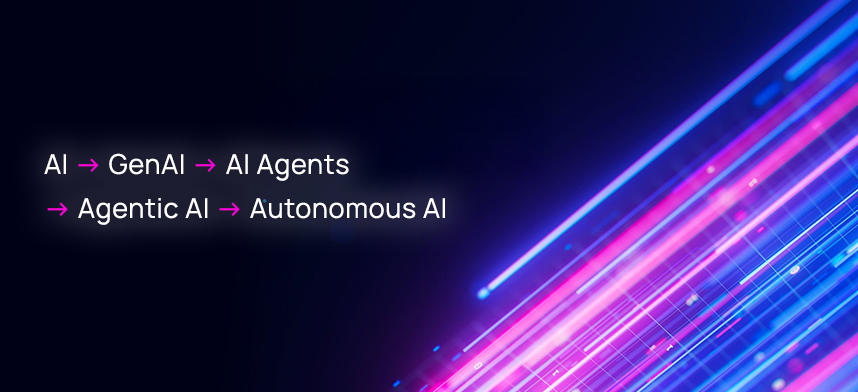
To use AI effectively, it helps to understand the different types of AI you’re likely to encounter in entity management platforms and how each type can support smarter, more efficient processes:
1. Artificial Intelligence (AI): the foundation
At its core, AI refers to computer systems that can perform tasks typically requiring human intelligence, such as recognizing patterns, making predictions, and automating routine processes. It serves as the foundation for all other specialized types of AI.
2. Generative AI (GenAI): creating content and insights
GenAI builds upon traditional AI by using advanced models to generate new content and provide deeper analysis, be it creating text, images, or data insights. A good example of this is ChatGPT. Within entity management platforms, GenAI can summarize documents, analyze large datasets, and surface risks.
3. AI Agents: acting on your behalf
AI agents run a series of defined tasks and analyses end-to-end on your behalf. In entity management, an AI agent can monitor deadlines, check for predefined risks, send reminders, and generate insights from your data, acting like an additional low-risk team member for repeatable work.
4. Agentic AI: pursuing goals
Agentic AI is a step beyond AI agents. Instead of following a fixed workflow, it’s goal-driven: given an objective, it can plan steps, adapt as conditions change, and potentially coordinate multiple agents or tools to reach the outcome, typically with human oversight built in.
5. Autonomous AI: operating independently
Autonomous AI represents the pinnacle of independence. These systems can operate, adapt, and learn with minimal human oversight – think warehouse robots that retrieve and pack items or self-driving taxis.
How AI supports entity management – from buzzwords to business value
Understanding the different types of AI is only meaningful if it results in measurable outcomes. In entity management, the real value of AI comes not from abstract terminology but from the tangible ways it enhances how work is executed, monitored, and managed within modern platforms.
AI delivers this value in several clear, practical ways:
• Automation of routine tasks
AI streamlines manual, repetitive processes, reducing the risk of human error and enabling teams to execute work faster and with greater consistency.
• Enhanced intelligence
With GenAI, teams can translate documents instantly, summarize dense or complex materials, and analyze large volumes of data to identify risks early and inform better decision-making.
• Proactive management
Agentic AI takes action with purpose – monitoring deadlines, tracking risks, sending reminders, and performing predefined tasks without needing a human prompt, acting like an additional low‑risk team member.
• Future possibilities
Autonomous AI represents the next evolution, where end‑to‑end processes could one day be managed independently, adapting automatically to regulatory changes in real time.
By grounding AI in real-world outcomes rather than buzzwords, entity management professionals can more clearly see how AI drives efficiency, reduces risk, and creates space for higher‑value strategic work. And even as autonomous AI evolves, human oversight will remain essential, ensuring that review and approval processes catch potential errors and maintain accuracy.
| AI type | What it does | How it helps | Impact in entity management |
|---|---|---|---|
| GenAI | Generates content and insights. | Quickly produces content and analysis to support faster decision-making. | Translates documents, generates summaries, and analyzes large datasets to surface risks. |
| AI Agents | Executes predefined tasks and analyses end-to-end. | Automates repeatable work with consistency and accuracy. | Tracks risks and deadlines, sends reminders, and supports teams like an extra low-risk “team member.” |
| Agentic AI | Pursues goals, coordinating actions or multiple agents. | Enables more dynamic and goal-driven automation. | Achieves higher-level objectives such as proactively managing complex compliance scenarios. |
| Autonomous AI | Operates and learns independently. | Runs complex processes end-to-end and adapts. | Could eventually manage full entity lifecycles and handle evolving compliance with minimal input. |
The future of entity management: driven by AI
Even if adopting AI feels daunting, understanding the different types of AI, and how they apply within an entity management system, makes integration far easier. AI isn’t about handing over entire tasks to machines; it’s about working smarter and amplifying the value of your existing processes and technology:
 Start small: Use AI within your entity management system to handle repetitive or time‑consuming tasks that slow teams down.
 - Measure the impact: Track improvements in efficiency, accuracy, and turnaround times as the system begins to automate and streamline more of your operational workload.
- Expand strategically: As your confidence grows, explore more advanced capabilities such as Agentic AI (AI Agents), to monitor tasks and surface risks.
The future of entity management is smarter, faster, and more strategic, with AI as an ally. By embracing it thoughtfully, teams can reduce risk, streamline operations, and focus on the high‑value work that machines can’t replicate.
And as AI continues to evolve, so will the opportunities for entity management professionals. As you assess entity management systems with built‑in AI capabilities, look for providers who prioritize client education and offer clear guidance on how to integrate these tools into your workflows — not just those who promise automation.
Computershare Entity Solutions and AI
Computershare Entity Solutions is at the forefront of AI innovation, developing AI capabilities within our Global Entity Management System, GEMS™ to help clients gain more efficiency and control over their entity management. Beyond advancing GEMS AI capabilities, we’re also leading the conversation around the use of AI in the entity management space, helping clients understand what AI is, how it works, and the ways in which they can implement it into their entity management processes.
Want to see GEMS AI in action?
Schedule a demo to discover how AI can elevate your entity management and streamline compliance across your organisation.