Employee Share Plans
Better experiences for every employee

If companies are listed in the United States or are subject to U.S. Securities and Exchange Commission (SEC) reporting requirements, they typically apply United States Generally Accepted Accounting Principles (US GAAP) In contrast, International Financial Reporting Standards (IFRS) applies to companies listed or reporting in jurisdictions outside the US, that have adopted those standards.
For multi-listed groups, the need to use both frameworks arises from their listing obligations, SEC filing requirements, and group consolidation structures, rather than just the fact they operate in multiple regions.
Understanding their overlap and their differences is essential for multi-listed companies to produce accurate and compliant disclosures.
US GAAP applies to companies listed in the US, with share-based compensation governed by ASC 718. A key feature is its rules-based approach, offering detailed guidance on areas such as grant date determination, fair value measurement, forfeiture estimates, and award modifications.
This level of detail supports consistency, but it can also make implementation more complex, especially for multinational groups that must reconcile US GAAP results with IFRS reporting at the group level.
IFRS is widely used outside the US, with share-based payments accounted for under IFRS 2. IFRS follows a principles-based approach, relying more on professional judgment when determining vesting conditions, award classification, and treatment of nonmarket performance conditions.
This flexibility can better accommodate different compensation structures, but it also increases the need for strong documentation and governance to ensure consistency across the group. (The group refers to the parent and all entities within the consolidation perimeter. Entity level books may follow local rules, but consolidation is performed under the parent reporting framework.)
Their differences are essential for multi-listed companies to produce accurate and compliant disclosures. Differences between ASC 718 and IFRS 2, combined with increasing regulatory scrutiny, add complexity and reporting risk. Listing location, regulatory requirements, and group reporting needs drive the accounting framework. Many multi-listed companies operate share plans, resulting in parallel reporting under both standards. Maintaining accurate and compliant share plan financial reporting requires a clear understanding of both frameworks.
Key challenges about multi-listed reporting commonly arise in areas such as:
 Expense recognition: ASC 718 and IFRS 2 use different forfeiture models, methods of recognition of share-based compensation and modification rules require dual runs to ensure US GAAP/IFRS expense is appropriately recognized.Managing equity settled and cash settled awards: Alternative settlement/cash alternatives and group arrangements can yield different balance sheet and P&L impacts and remeasurement requirements.Intercompany transfers: Tracking participant movements between a parent company and its subsidiaries within a multinational corporation can be challenging to capture but is essential for its share-based compensation recognition.
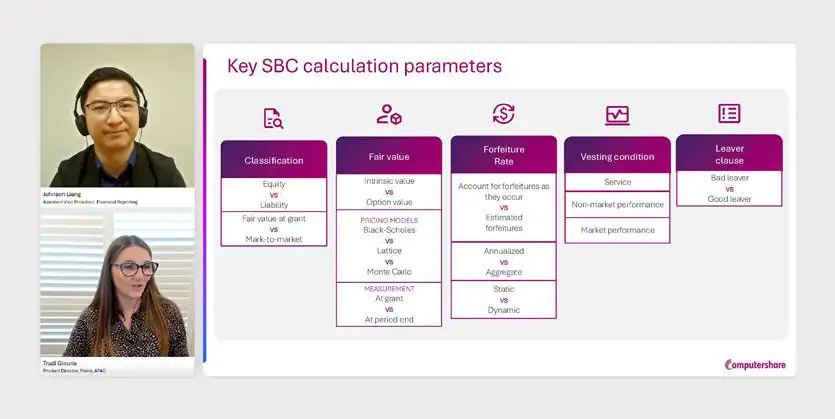
Several technical areas consistently drive divergence between ASC 718 and IFRS 2, these differences directly affect expense timing, classification outcomes, and disclosure requirements:
Expense method: both straight-line attribution and accelerated attribution are permitted under ASC 718, while only accelerated attribution is allowed under IFRS.Forfeitures: IFRS 2 requires estimating expected forfeitures with true ups through the vesting date. ASC 718 permits a policy election to either estimate forfeitures or recognize them as they occur.Modifications: Both analyse changes in fair value and period of expense recognition, but definitional nuances often produce different catch up and future period expense patterns.As expected, changes and updates occur regularly when it comes to accounting standards and reporting requirements. Below are the latest US GAAP updates:
ASU 2025-04: Share-Based Consideration Payable to a Customer
Issued: May 2025 by the FASB
Key Changes:
Revised Definition of Performance Condition for share-based consideration payable to a customer: Now explicitly includes vesting conditions and performance targets tied to customer's purchases.Elimination of Forfeiture Policy Election: When measuring share-based consideration payable to a customer that has a service condition, the grantor is required to estimate the number of forfeitures expected to occur.Effective Date: Annual periods beginning after 15th December 2026 (early adoption permitted)ASU 2024-01: Scope Application of Profits Interest and Similar Awards
Issued: April 2024 by the FASB
FASB has added an illustrative example to demonstrate how an entity should apply the scope guidance in paragraph 718-10-15-3 to determine whether profits interest and similar awards should be accounted for in accordance with Topic 718, Compensation—Stock Compensation.
The increasing use of equity compensation has elevated share plan financial reporting into a complex, multi disciplinary area. Differences between US GAAP and IFRS, combined with frequent regulatory changes, continue to add to the reporting burden. Many multinational companies rely on specialised service providers to navigate this complexity. A strong share plan financial reporting service provider can support by translating technical accounting guidance into practical, scalable processes tailored to their specific plans and jurisdictions. In addition, providers can serve as an ongoing source of insight, monitoring regulatory developments, standard updates, and evolving market practices that may impact share plan accounting.
[1] Source: https://www.fasb.org/standards/accounting-standard-updates
We have over 1,000 equity experts across all major markets, ready to help you design and deliver the right employee equity solutions.