Employee Share Plans
Better experiences for every employee

Different plan types create distinct reporting obligations that ANZ listed companies need to be aware of. obligations across Australia. Compared to long-term incentive plans (LTIs), employee stock purchase plans (ESPP) are more complicated in terms of accounting handling and impact due to its nature. ESPPs allow employees to buy company shares through salary deductions, with the company providing matching or discounted shares as an incentive.
Globally, there are two main ESPP types. Company goals and objectives may help determine which plan type is best for a company to implement.
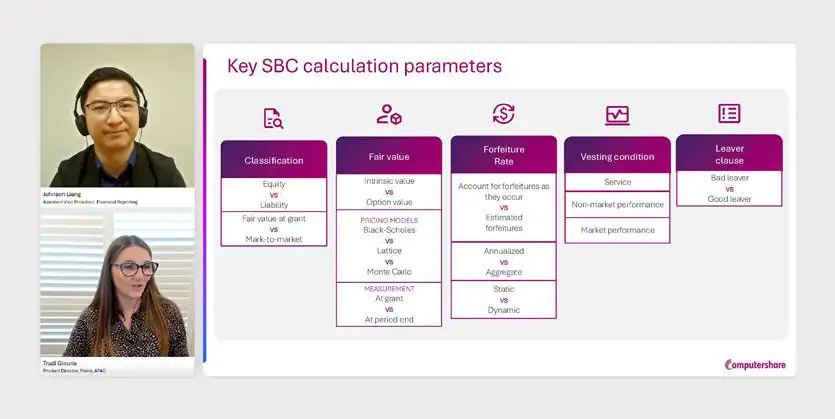
ESPPs can give rise to a range of accounting and reporting obligations. One key consideration is the offering period, which typically runs for 12 to 24 months and includes a series of purchase periods during which employees set aside money through regular payroll deductions to purchase shares. Each purchase period under an ESPP can be regarded as a separate share option with fair value calculated and accrued over the offering period. Tranche-by-tranche valuation and acceleration attribution is applicable under ASC 718 and IFRS 2. ASC 718 (under US GAAP) outlines standard accounting guidelines for stock compensation providing specific rules on how companies should record and report any expenses related to equity-based compensation. IFRS 2, meanwhile, is an international accounting standard requiring companies to recognize share-based payment transactions and report profit or loss in their financial statements.
Global ESPP plans can have varying accounting implications. For instance, when employees relocate to different countries, it's crucial to consider the accounting impacts of changes in their contribution amounts. Partnering with an expert in global financial reporting is essential.
While these are some of the more common implications, it's important to recognize there can be additional accounting and reporting obligations specific to each country's rules and regulations. Partnering with a knowledgeable and experienced expert who can manage all accounting and financial reporting requirements is a significant advantage for companies globally.
We have over 1,000 equity experts across all major markets, ready to help you design and deliver the right employee equity solutions.