
Share Registry
Industry Insights: Modernising corporate reporting

LONDON, 2 September 2026 – Executive pay attracted the most shareholder dissent across nine key European markets during the 2026 annual general meeting season, with opposition to remuneration reports and policies at 30.9%, according to Georgeson.
The global shareholder engagement firm analysed proxy results from annual meetings in the UK, Germany, France, Switzerland, the Netherlands, Italy, Spain, Belgium and Ireland for its 2026 European AGM Season Review.
Shareholder opposition to remuneration reports and policies declined from 34.5% in 2025 to 30.9% this year, but the category remained the most contested resolution topic.
Georgeson said the gap between shareholder opposition to future executive pay structures and Say on Pay widened by 11.4 percentage points, compared to 6.8 percentage points in 2025.
The data suggest investors continue to scrutinise the design of future pay arrangements more closely than companies' past pay decisions.
Other contested resolution categories included:
 Share issuance authority, which fell to 13.4% from 18.9% last yearDirector elections, which rose to 12.4% from 12.2% last year
Cas Sydorowitz, Head of Georgeson Advisory, said: “Overall shareholder opposition declined, but voting outcomes have become less predictable as investors adopt more varied approaches to voting and stewardship.
“Customised voting policies, changing proxy advisor models, divided responsibilities across investment teams and changing internal stewardship frameworks are creating a more fragmented landscape.
“Companies must look beyond headline dissent levels and engage shareholders to understand their priorities and what drives their decisions.”
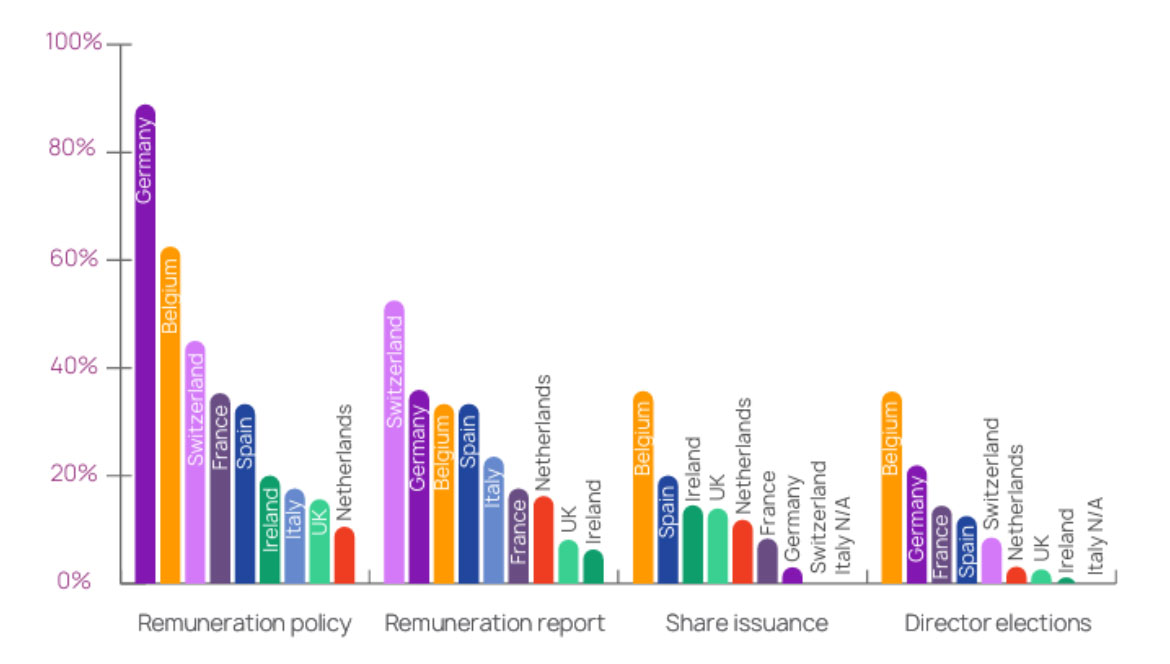
Germany recorded the highest proportion of contested remuneration policies (88.9%), and the Netherlands had the lowest proportion (10.5%).
Remuneration reports saw the most dissent in Switzerland (52.5%) and the least in Ireland (6.3%).
The UK recorded the second lowest shareholder opposition for both remuneration policies (15.6%) and remuneration reports (8.1%).
Opposition to remuneration policies remained materially higher than that of remuneration reports.
Director elections were the only major resolution category to record increased opposition across the eight comparable markets, rising to 12.4% from 12.2% in 2025.
Opposition increased in Belgium, Germany, Spain, Switzerland and the UK, while it declined in France, the Netherlands and Ireland.
Georgeson said the modest increase in dissent indicates investors may be more willing to hold directors accountable for governance, oversight and board effectiveness.
Contested share issuance authority resolutions declined on average to 13.4% in 2026 from 18.9% in 2025, with the Netherlands the only market to record an increase.
Kirsten van Rooijen, Integration CEO of Investor Engagement, Computershare, said: “Georgeson's analysis of the European AGM season underlines how changing investor expectations and voting approaches require companies to understand who their shareholders are and what drives their decisions.
“A connected year-round engagement practice, supported by a strong technology platform, gives companies the timely insights they need to focus their outreach, understand emerging risks and make better-informed decisions.”
Georgeson is part of Computershare's Investor Engagement services, which brings together investor intelligence, investor relations technology and strategic advisory services to help companies understand and engage their investors.
To request Georgeson's European Season Review, please go to https://www.georgeson.com/uk/insights/2026-european-agm-season-review.
Notes
1. The 2026 proxy season began on 1 July 2025 and ended on 30 June 2026. Similarly, the 2025 proxy season began on 1 July 2024 and ended on 30 June 2025.
2. Percentages reflect a weighted average that accounts for the differences in market size across the nine European countries.
3. Georgeson defines a contested resolution as one that receives at least 10% shareholder opposition, whether the proposal passes or not.
4. Italian companies employ a slate voting system, which means that significant shareholders nominate directors and that very few directors are elected individually. As a result, the data reported on director elections exclude Italy.
5. For high-resolution images of spokespeople, visit www.computershare.com/corporate/spokespeople.